By Editorial Team · Last updated September 2026
Sulawesi's problem is not deciding what to see, it is that the best parts sit at opposite ends of a very large island with no fast way between them. Ten days forces you to pick two anchors and fly over the middle. Fourteen days buys you the middle itself, the Togean Islands, and that changes the shape of the trip completely: instead of skipping the gap you travel through it, by road and by ferry, in one line from south to north. The catch is that the line depends on boats that sail on fixed weekdays, so this is a trip you plan backwards from a timetable.
Who is this Sulawesi route for?
This route suits independent travellers who are comfortable with thirteen-hour bus days, boats that sail twice a week, and small islands where almost nothing can be arranged in advance. It works best for solo travellers and for repeat visitors to Indonesia who have already done Bali or Lombok and now want a trip measured in distance rather than in comfort.
It also works for couples who travel light and make decisions quickly, because several links in this chain depend on catching a boat that leaves once and does not care that you slept badly.
It is the wrong trip for a first visit to Indonesia, for families with young children, and for anyone whose two weeks are precious enough that a missed ferry would ruin them. If that is you, the ten-day version of this trip skips the middle section entirely and flies over the gap instead. There is no shame in that, it is the more sensible trip.
Trip at a glance
Route: Makassar, Tana Toraja, Tentena, Ampana, the Togean Islands, Gorontalo, Manado, Bunaken. One line, south to north, with no backtracking.
Best for: Toraja funeral culture, four unhurried nights in the Togeans, and the reef walls off Bunaken at the end.
Pace: Demanding at both ends, slow in the middle. Roughly five of the fourteen days are spent moving, including one overnight ferry.
Base changes: Six. Makassar, Rantepao, Tentena, Ampana, a Togean island, then Manado and Bunaken.
When to go: The drier months, roughly May to September or October, when the Gulf of Tomini is calmest and the mountain roads are least likely to slide. Toraja ceremonies cluster in July and August.
Internal flights needed: None. One optional flight can replace the Gorontalo to Manado road leg if you would rather buy back a day.
Why does this route run south to north?
Because the ferries do. The crossing between the Togean Islands and Gorontalo runs on fixed weekdays in each direction, and the northbound sailing lands you at dawn in the right place for Bunaken. Running the trip in reverse means arriving in Toraja tired at the end, when the highland days are the ones that most reward energy.
Sulawesi is shaped like a sprawling letter K and its best parts sit at the ends of the arms. Tana Toraja is inland in the south, reached overland from Makassar. Bunaken is a boat ride off Manado in the far north. The Togean Islands sit in the middle of the Gulf of Tomini, which is exactly why a ten-day trip cannot include them: the ten-day version flies from Makassar to Manado and skips the middle. Add four days and the middle becomes reachable overland, and the whole island reads as one continuous journey instead of two separate holidays.
That is the real trade you are making. You are not buying four extra days of beach. You are buying the connective tissue.
How do you actually reach the Togean Islands?
There are two realistic ways in, and both take most of a day. From the south you travel overland to Ampana and take a speedboat across to Wakai, about four to five hours. From the north you take the overnight ferry from Gorontalo, about twelve hours across the Gulf of Tomini. This route uses the first on the way in and the second on the way out.
| Way in | Journey | How often | Best for |
|---|---|---|---|
| Overland to Ampana, then a speedboat | Rantepao to Tentena is a 13 to 15 hour bus, Tentena to Ampana about 5 hours, then 4 to 5 hours by speedboat to Wakai | Speedboats most mornings, plus a car ferry roughly three days a week | Travellers coming up from Toraja who want the island in one unbroken line |
| Overnight ferry from Gorontalo | About 12 hours across the Gulf of Tomini, leaving mid to late afternoon and landing around dawn | Roughly twice a week in each direction | Arriving from Manado, or leaving the islands northbound as this route does |
| A regional flight into central Sulawesi | Intermittent, and it still leaves a road transfer to Ampana at the end of it | Routes have come and gone | Only worth planning around if you can confirm a flight on your exact dates |
The operator of the Ampana crossings publishes its schedule month by month and adjusts it for weather, which is why nobody sensible books non-refundable onward travel around a Togean departure. Buy tickets at the official counter, and give yourself the buffer nights this itinerary builds in.
Day 1: Arrive in Makassar
Afternoon. Land at Sultan Hasanuddin International Airport, airport code UPG. Most travellers connect through Jakarta, Bali, Singapore or Kuala Lumpur, so confirm current flight routes before you lock any hotels. A night here means you start the Toraja drive rested rather than groggy off a long-haul connection.
Evening. Eat at the Losari waterfront, which is the reason to be in the city at all. Fort Rotterdam is a calm hour near the seafront if you land early.
Travel note: Set up an Indonesia eSIM with Airalo before you leave the terminal. Signal holds in Makassar, Manado and Gorontalo, thins badly on the Trans-Sulawesi road, and is patchy to absent in the Togeans. Download offline maps tonight, not on day six.
Base: Makassar stays, one night.
Day 2: Makassar to Tana Toraja
Tana Toraja sits roughly 300 to 310 kilometres north of Makassar on a winding mountain road. As a working estimate the drive runs eight to ten hours depending on traffic leaving the city, rest stops and roadworks. Leave early.
Morning. Decide the transfer before today rather than at the terminal. A private car with a driver is the most comfortable option and lets you stop at the Bambapuang viewpoint on the way. Long-distance buses also run the route, many of them overnight, with standard seats commonly advertised from around 150,000 rupiah and VIP seats nearer 200,000, though fares change. You can compare Makassar to Toraja transfers to see current options and rough prices.
Evening. Arrive in Rantepao, the practical base for the highlands. Eat early, sleep early. Tomorrow is the first full day on foot.
Base: Rantepao stays, three nights.
Booking logic: Stay in or near Rantepao rather than Makale. It puts you closer to most village sites and to the guides and drivers who arrange them.
Day 3: Southern Toraja, the graves and the effigies
Morning. Start with the southern loop. Lemo is a cliff face lined with carved burial niches and rows of tau tau, the wooden effigies that stand watch over the dead. Londa is a cave and cliff site where coffins and skulls sit in the rock, usually visited with a local guide carrying a lamp.
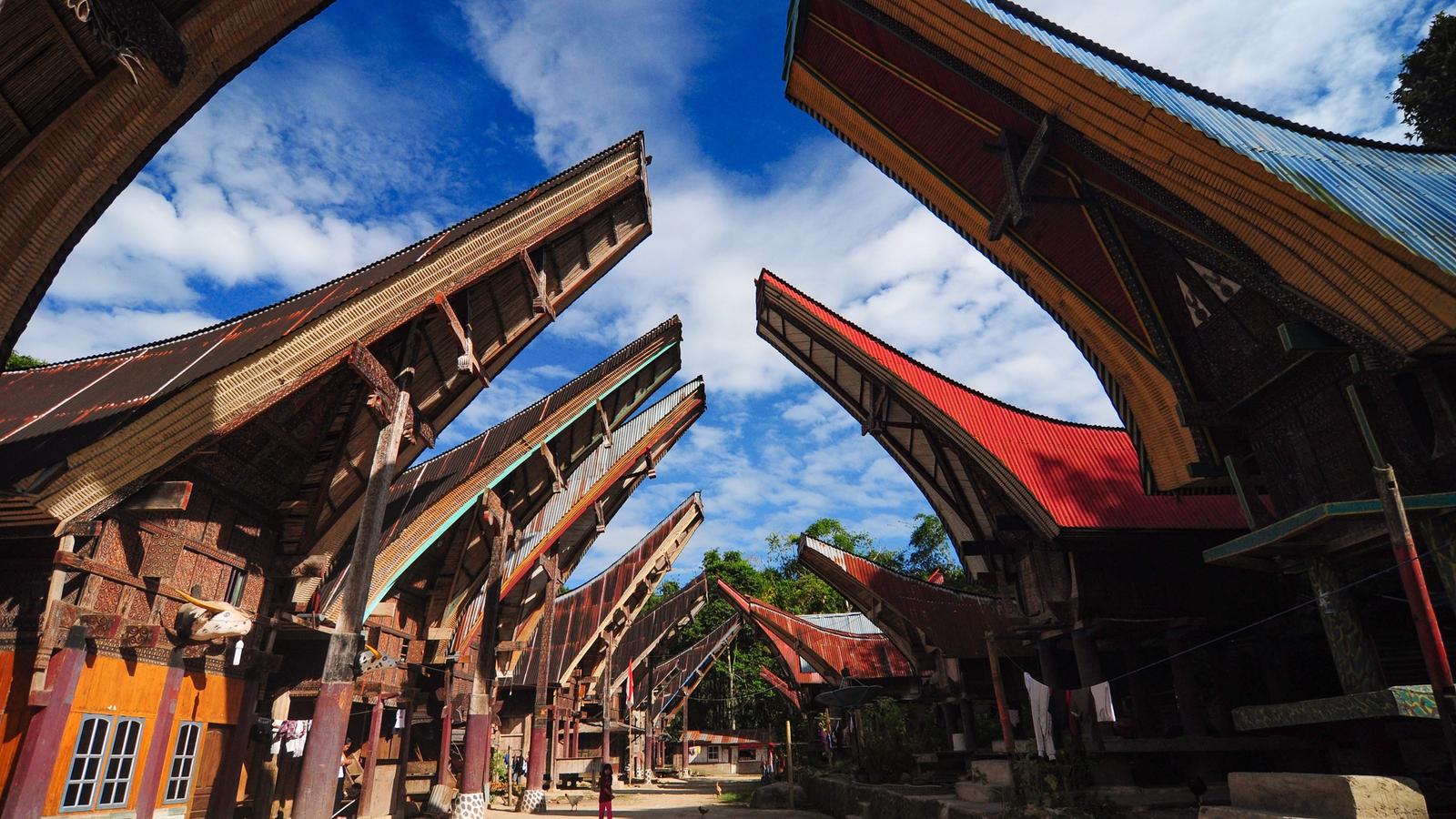
Afternoon. Continue to Kete Kesu, a village of tall tongkonan houses with boat-shaped roofs, rice barns facing them across the yard, and an old burial ground on the hillside behind.
Travel note: Village sites charge small entry fees, often a few tens of thousands of rupiah each, paid in cash. Carry small notes. Cards are rare outside Rantepao and fees change.
Evening. Back in Rantepao. If a funeral ceremony falls during your stay, your guide will know, and attending one is the single strongest reason to be in Toraja. Bring a gift of cigarettes or sugar, dress modestly, and follow your guide's lead on where to sit and when to photograph.
Day 4: Northern Toraja and the Batutumonga ridge
Morning. Drive north and up. Bori Parinding is a ceremonial ground studded with standing stones, each raised for a funeral, and it makes the scale of these ceremonies legible in a way no photograph does. Pallawa has one of the finest rows of tongkonan in the region.
Afternoon. Climb to Batutumonga on the slopes of Mount Sesean for the view back down over the rice terraces of the whole valley. If you have the legs for it, walk part of the descent rather than driving it. This is the best walking in Toraja and the only day of the trip with real time for it.
Evening. Last night in Rantepao. Repack tonight, because tomorrow starts before breakfast and you will not want to be sorting bags at six in the morning.
Travel note: Buy tomorrow's bus ticket today, in person, and confirm the departure time twice. Seats on the Tentena buses are limited and this is the leg the whole rest of the trip hangs from.
Day 5: Rantepao to Tentena, the long one
This is the hardest day of the trip and there is no way to soften it. Buses leave Rantepao in the morning, commonly around eight or nine, and reach Tentena thirteen to fifteen hours later, often close to ten at night. Fares are commonly quoted around 250,000 rupiah, though this changes.
All day. The road climbs out of the Toraja highlands, drops through central Sulawesi, and eventually reaches the shore of Lake Poso. Take food, water and something to read that does not need a screen. Rest stops are infrequent and basic.
Evening. Arrive in Tentena tired. There is no public transport waiting at the drop-off point at that hour, so book a room in advance and ask the guesthouse to arrange a pickup. This is not optional advice, it is the difference between a bad evening and a very bad one.
Base: Tentena, one night, on the northern shore of Lake Poso.
Travel note: If a fifteen-hour bus is more than you want to sign up for, this is the leg to buy your way out of. A private car covers the same ground with stops, at several times the price. Split between two or three people it stops being extravagant.
Day 6: Tentena to Ampana
Morning. Wake up somewhere quietly beautiful. Lake Poso is enormous, clear and almost empty of travellers, and an hour by the water before you leave is the reward for yesterday. If you have energy, the Saluopa waterfall nearby is a short trip.
Afternoon. Head for Ampana. A shared car covers Tentena to Ampana in roughly five hours for around 300,000 rupiah as a working figure. Doing it in stages is cheaper and slower: a bemo to Poso takes about two hours for something like 38,000 rupiah, then a bus on to Ampana takes about four hours for around 80,000. Prices are indicative and change.
Evening. Sleep in Ampana. It is a working port town, not a destination, and that is fine. You are here because the boat leaves from here in the morning.
Base: Ampana stays, one night.
Booking logic: Book the Ampana night even if you think you can connect straight through. Arriving late and missing the morning speedboat costs you a full day in the Togeans, which is the part of the trip you added four days for.
Day 7: Ampana to the Togean Islands
Morning. Two public speedboats work the Ampana to Wakai crossing, one leaving around nine and the other in the early afternoon, taking roughly four to five hours. A larger car ferry runs the same leg about three days a week and is slower but steadier in rough water. Buy at the official counter, in cash, well before departure.
Afternoon. Cross the Gulf of Tomini. The water changes colour about an hour out and the islands start appearing as low green humps. From Wakai, most accommodation sends a boat to collect guests, which is why you tell them your arrival date in advance.
Evening. Settle in on Kadidiri, the most straightforward base near Wakai, with a cluster of simple resorts and dive operations. Electricity is often generator-only and runs on a schedule. Charge everything when it is on.
Base: Kadidiri or a nearby island, four nights.
Travel note: There is no ATM you should rely on in the Togeans. Draw all the cash you will need in Ampana, and add a comfortable margin for boat trips, park fees and the ferry out.
Day 8: Diving and snorkelling off Kadidiri
Morning. The Togeans hold reef, wall and wreck diving within easy boat range, and the operators on Kadidiri run fun dives, snorkelling trips and beginner courses. Visibility is generally good in the dry months. If you are certified, two dives today is the natural rhythm.
Afternoon. Snorkelling straight off the beach is genuinely worthwhile here, which is not true everywhere. If you are not diving, ask about the day trips to the outer reefs.
Evening. Dinner is served at a set hour at most places and there is nothing else open. This is the point of the Togeans rather than a complaint about them.
Booking logic: Message your dive operator before you arrive with your certification level and dates. Boats fill in the July and August window and gear in larger or smaller sizes is limited.
Day 9: The jellyfish lake and the stilt villages
Morning. Take the day trip toward Katupat and the Mariona lake, a landlocked saltwater lake holding stingless jellyfish you can swim among. Keep expectations elastic, the number of jellyfish varies a great deal with season and conditions, and some visits are spectacular while others are quiet.
Afternoon. Stop at one of the Bajau stilt villages built out over the reef. These are working communities, not attractions, so ask before photographing anyone and buy something while you are there.
Evening. Back to base. The boat day is long and the sun on open water is stronger than it feels.
Travel note: These trips are arranged locally the day before, priced per boat rather than per person, and are much cheaper if you find two or three other travellers to share with. Ask at dinner the night before.
Day 10: A slow day, or the volcano dive at Una Una
Morning. Divers should push for the day trip out to Una Una, the volcanic island west of Kadidiri, which most operators rate as the best diving in the archipelago. It is a longer boat ride and it needs settled weather, which is why it lives on a flexible day rather than a fixed one.
Afternoon. Everyone else: do nothing, deliberately. This is the only genuinely empty afternoon in fourteen days and the trip is better for having one.
Evening. Confirm tomorrow's ferry. Ask your host to check the sailing rather than trusting a schedule you read online three weeks ago.
Day 11: The overnight ferry to Gorontalo
Morning. A last swim, then the boat back to Wakai. Time this generously. Local transfers run on their own logic and the ferry does not wait.
Afternoon. The Wakai to Gorontalo crossing has typically sailed on Mondays and Thursdays, leaving mid-afternoon, with the southbound run from Gorontalo on Tuesdays and Fridays in the late afternoon. The passage takes around twelve hours. Economy and business class are sold publicly, cabins are limited and not always available, so bring a sleeping mat or sarong and pick your spot on deck early.
Evening. Sleep at sea, badly, in good company. This is one of the more memorable nights of any Indonesian trip and it costs almost nothing.
Base: The ferry.
Travel note: The operator publishes this schedule monthly and shifts it with weather. Two of your Togean days exist as insurance against a cancelled sailing. If the boat runs on time, you spend that margin lying on a beach, which is not a loss.
Day 12: Gorontalo to Manado
Morning. Land in Gorontalo around dawn. Find breakfast and a shower before you commit to anything else.
Afternoon. Gorontalo to Manado is roughly 400 kilometres of coastal and inland road, commonly eight to ten hours by bus or by the shared cars known locally as kijang. Flights between the two also operate and turn the day into a couple of hours, which is the single best use of money on this entire route if your budget stretches to it.
Evening. Arrive in Manado. Eat Minahasan food, which is spicier and stranger than anything you have had further south, and sleep in a real bed.
Base: Manado stays, one night.
Day 13: Manado to Bunaken
Morning. Public boats to Bunaken leave from Manado and are cheap, slow and tied to a daily departure window, so most resorts run their own transfer instead. Book that transfer with your room rather than improvising at the pier.
Afternoon. First dives or first snorkel. Bunaken's reputation rests on its walls, where the reef drops away vertically a short boat ride from shore, and it holds up. There is a marine park entrance fee, widely reported at around 150,000 rupiah per person, usually collected on arrival and payable in cash. Fees change, so confirm the current amount with your resort.
Evening. Watch the sunset from the west-facing side of the island with the volcanoes of the mainland on the horizon.
Base: Bunaken stays, two nights.
Day 14: Bunaken, then the flight out
Morning. One more dive or a long snorkel over the wall. If you have dived all week, today is the day to stop, because most flights out of Manado connect through Jakarta or Singapore and you want a clear surface interval before flying.
Afternoon. Transfer back to Manado. Sam Ratulangi airport, airport code MDC, is close to the city.
Travel note: Leave a real buffer between the Bunaken boat and your flight. Sea conditions cancel the crossing occasionally, and unlike every other transfer on this trip, this one has a deadline attached.
What should you book early, and what can wait?
Book three things well ahead: your international flights, the four nights in the Togeans, and the room in Tentena with a pickup arranged. Everything else on this route is bought locally a day or two before, and booking it early only makes you inflexible when a boat changes its mind.
Book early. International flights and the Manado exit. Togean accommodation, especially July and August, because there are only so many beds. The Tentena guesthouse with a confirmed late pickup. Bunaken resort plus its boat transfer.
Leave flexible. The Makassar to Toraja transfer, which can be arranged a day ahead. All Togean boat trips, which are cheaper and easier arranged on the island. The Gorontalo to Manado leg, so you can choose road or air once you know how you feel at six in the morning after a night on a ferry.
Never book non-refundable around a ferry date. The Togean sailings shift with weather, and any onward booking that cannot move turns a small delay into an expensive one.
Mistakes travellers make on this crossing
The most common mistake is treating the Togean ferries as daily transport. They are not. They sail on fixed weekdays, they move with the weather, and a traveller who arrives in Ampana on the wrong day loses two or three of the days they came for. Plan the middle of this trip backwards from the sailing you intend to catch.
Running out of cash in the Togeans. There is no reliable ATM. Boat trips, park fees and the ferry out all want rupiah in hand. Draw it in Ampana, then draw more than that.
Underestimating the Rantepao to Tentena bus. Fifteen hours is not a long day, it is most of a day and all of an evening. Arriving without a room and a pickup arranged is the classic error on this leg.
Building the trip around a regional flight. Small routes in central Sulawesi have appeared and vanished more than once. Use one if you can confirm it, but the itinerary should still work without it.
Diving on the last morning. A dive the day you fly is a genuinely bad idea, and Manado connections are usually long. Stop diving after Day 13.
Arriving in the wet months. From roughly November to March the Gulf of Tomini gets rough, crossings get cancelled, and the mountain road north of Toraja is at its worst. This is a dry-season route and it is not close.
Should you do this in ten days or fourteen?
Fourteen days is the minimum that fits the Togean Islands honestly. Ten days can pair Toraja with Bunaken by flying between Makassar and Manado, which is a good trip, but the middle of Sulawesi is simply not reachable in that time. The four extra days buy the archipelago and remove the backtrack, and they cost you three additional travel days.
| What changes | The 10-day version | This 14-day version |
|---|---|---|
| Route shape | Makassar to Toraja and back, then a flight north to Manado | One continuous line south to north, no backtrack |
| Togean Islands | Not included, they do not fit | Four nights, and the whole reason for the extra days |
| Days spent moving | About two long transfer days | About five, one of them an overnight ferry |
| Internal flights | One, Makassar to Manado | None required, one optional to shorten the Gorontalo leg |
| Fragile connections | None, flights run daily | Two fixed-weekday ferries, which is what you plan around |
| Who it suits | Couples and friends who want range without roughing it | Solo travellers and repeat visitors who treat the journey as the point |
What to cut, adapt or upgrade
Cut the Tentena night only if you have arranged a private car for the whole Rantepao to Ampana run and are willing to do it in one very long day. You lose Lake Poso, which is a genuine loss, but you gain a day in the Togeans.
Adapt the Gorontalo leg. If the overnight ferry has emptied you out, fly Gorontalo to Manado and spend the recovered afternoon on Bunaken instead of on a bus.
Upgrade the Toraja days with a proper local guide rather than a driver. In Toraja a guide changes what you understand rather than merely easing the logistics, and it is the one place on this route where that is true.
Add three days and you can reach the Lembeh Strait from Manado, which pairs the reef walls of Bunaken with some of the best macro diving anywhere. That combination has a trip of its own.
Or change archipelago altogether. If the Ampana ferry and the night on deck are the part of this route that appeals rather than the part you tolerate, the nine-day Banda Islands route asks the same thing of you and pays it back in nutmeg groves, a climbable volcano and coral walls instead of highland graves.
Before you build this trip
Visa. Most nationalities use a visa on arrival for Indonesia, extendable once. Fees and rules change, so check the latest official guidance close to departure rather than trusting a blog, including this one.
Cash. This is one of the most cash-dependent routes in Indonesia. ATMs are dependable in Makassar, Rantepao, Poso, Gorontalo and Manado, and functionally absent in the Togeans. Plan withdrawals as part of the itinerary.
Language. English is limited outside dive resorts. A translation app that works offline earns its place here more than in most of Indonesia.
Health and insurance. This is a dry-season trip, roughly May to October. Confirm your travel insurance covers diving to the depths you actually dive, and note that decompression facilities are far away from the Togeans.
Timing. Toraja ceremonies concentrate in July and August, which is also when the Togean beds fill and the seas are calmest. That overlap is real, so book accommodation earlier if you travel then.
Final verdict: is the Togean detour worth six extra days of travel?
Yes, but only if the travelling itself appeals to you. Take the four extra days purely as beach time and this trip is poor value: the Togeans are lovely and unhurried, not extraordinary, and you could reach better-known reefs faster and cheaper elsewhere in Indonesia. What is extraordinary is the line you draw across the island to get there.
The version of this trip worth having is the one where the fifteen-hour bus, the port town in Ampana and the night on the deck of a ferry are not the price of the holiday, they are the holiday. If you read that sentence and felt tired, take the ten-day route and fly the gap. If you read it and felt something else, this is your trip.
Related itineraries
If you would rather skip the middle section, the 10-day Sulawesi route through Toraja and Bunaken pairs the same two anchors and flies between them. For a reef-led trip that gives northern Sulawesi a full holiday of its own, the 10-day North Sulawesi diving itinerary adds the macro life of the Lembeh Strait.
For an even longer journey through Indonesia's frontier regions, the 20-day wild Indonesia route strings several of them together, and the wild Indonesia destination hub collects everything we have written about this side of the country.
Before you go
Sort the practical side
Entry rules and a realistic budget before you book this trip.
Good to know
Frequently asked questions
Is two weeks enough for Sulawesi?
Two weeks is the minimum that fits Tana Toraja, the Togean Islands and Bunaken in one continuous overland and ferry route. Roughly five of those days are spent moving. With ten days you can still pair Toraja with Bunaken, but you fly between them and the Togean Islands do not fit at all.
How do you get from Tana Toraja to the Togean Islands?
Overland, in two stages. A bus from Rantepao to Tentena takes about thirteen to fifteen hours, then a shared car covers Tentena to Ampana in around five hours. From Ampana a speedboat crosses to Wakai in the Togeans in four to five hours. Splitting it across two days with a night in Tentena is the sane version.
Do the ferries to the Togean Islands run every day?
No, and this is the single most important thing to plan around. Speedboats from Ampana run most mornings, but the longer crossings work on fixed weekdays. The Wakai to Gorontalo overnight ferry has typically sailed twice a week in each direction, and schedules are published month by month and shift with weather.
Can you do this route without any internal flights?
Yes. Every leg from Makassar to Manado can be covered by road and sea, which is the point of the route. The one place a flight genuinely helps is Gorontalo to Manado, replacing an eight to ten hour drive on the morning you land off an overnight ferry. Treat it as an optional upgrade, not a requirement.
What is the best time of year for this trip?
The drier months, roughly May to September or October. That window gives the calmest seas in the Gulf of Tomini, the most reliable boat crossings and the best condition on the mountain roads. From November to March crossings are cancelled more often. Toraja funeral ceremonies cluster in July and August.
Is Sulawesi a good destination for solo travellers?
Yes, with a caveat. The buses, ferries and guesthouses are easy to navigate alone and you will meet other travellers in Toraja and the Togeans. The caveat is cost: boat trips in the Togeans are priced per boat rather than per person, so solo travellers should plan to share and ask around at dinner the night before.
How much cash should you carry for the Togean Islands?
Enough for the entire stay plus the ferry out, drawn in Ampana before you cross. There is no ATM in the Togeans you should rely on. Accommodation, meals, boat trips and dives are usually settled in cash, and running short means cutting your stay rather than finding a machine.
Is the Bunaken marine park fee separate from diving costs?
Yes. Bunaken National Marine Park charges an entrance fee, widely reported at around 150,000 rupiah per person, usually collected in cash on arrival and separate from any dive package. Fees change, so confirm the current amount with your resort before you travel.
Keep exploring
Related itineraries

One week (6-8 days) · Wild Indonesia
7 Days in West Sumbawa: Whale Sharks, Moyo Island and Kenawa
A 7-day West Sumbawa itinerary: whale sharks in Saleh Bay, Moyo Island's Mata Jitu waterfall and Kenawa, with flights, ferries, costs and seasons.

One week (6-8 days) · Wild Indonesia
6 Days in Belitung: Granite Beaches and Island Hopping from Jakarta
A relaxed 6-day Belitung itinerary from Jakarta: granite beaches, Lengkuas island hopping and a family pace, with flights, boat costs and when to go.

One week (6-8 days) · Wild Indonesia
8 Days in North Sulawesi with Kids: Bunaken, Tarsiers and the Highlands
An 8-day North Sulawesi family route: snorkel Bunaken from Siladen, see tarsiers at Tangkoko at dusk, then cool off in the Tomohon highlands.
Share this itinerary