The short answer
You do not really have to choose. The two are close enough to Yogyakarta, and to each other, that a long day with a driver can cover both. But they are very different in character. Borobudur is a vast, low Buddhist monument built to be walked up and around, ending in a crown of stone stupas. Prambanan is a cluster of tall, slender Hindu temples that reach skyward like spires. Below is how to decide if your time is tight.
Borobudur: the great Buddhist monument
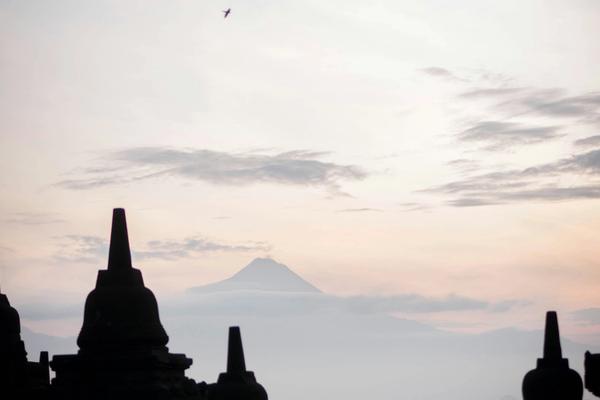
Built in the 9th century, Borobudur is the largest Buddhist temple in the world and a UNESCO World Heritage Site. It is shaped as a stepped pyramid: nine stacked platforms wrapped in carved relief panels that tell Buddhist stories, topped by perforated stupas around a central dome. The classic experience is sunrise, when mist hangs over the surrounding palm forest and distant volcanoes catch the first light.
Access has changed in recent years. Climbing onto the temple terraces is now regulated to protect the stone, with limited daily numbers, timed entry, a guide, and special sandals, typically booked through the official temple programme rather than just turning up. Sunrise access in particular runs through a paid scheme, so verify the current rules and book ahead.
Prambanan: the grand Hindu complex
Prambanan, also 9th century and also UNESCO-listed, is the largest Hindu temple complex in Indonesia. Where Borobudur is broad and rounded, Prambanan is vertical and sharp: a central courtyard of tall, ornately carved spires dedicated to the Hindu trinity, with the towering Shiva temple at its heart. The reliefs here narrate the Ramayana, and in the dry season an open-air Ramayana ballet is staged with the floodlit temples as a backdrop.
How do Borobudur and Prambanan compare?
Borobudur is the larger, older Buddhist monument and the better sunrise visit; Prambanan is the taller Hindu complex, closer to Yogyakarta and best in late afternoon. If you have one morning, choose Borobudur. If you have one afternoon or want the Ramayana ballet, choose Prambanan. Most travellers do both in one day with a driver.
| Borobudur | Prambanan | |
|---|---|---|
| Religion | Buddhist (Mahayana) | Hindu (Shiva, Vishnu, Brahma) |
| Built | 8th to 9th century | Around 850 AD |
| Scale | 9 stacked platforms, 504 Buddha statues, 2,672 relief panels | 240 temples originally; the main Shiva temple is 47 m tall |
| From Yogyakarta | About 40 km northwest, 1 to 1.5 hours by car | About 17 km east, 30 to 45 minutes |
| Best time | Sunrise | Late afternoon, and Ramayana ballet evenings |
| Climbing | Upper terraces only on a guided climb ticket, daily quota | Walk at ground level and enter the shrines |
| UNESCO listed | 1991 | 1991 |
Doing both in one trip
The efficient plan is a single full day with a driver: start at Borobudur early to beat the heat and crowds, then cross to Prambanan for the afternoon, finishing with the ballet if it is running. If you would rather not rush, split them across two days and use the spare time for the city's kraton and batik. Either way, base yourself in the city and see our things to do in Yogyakarta guide for the rest. Both temples feature on our 7-day Yogyakarta and East Java itinerary.
For where the temples sit inside a wider Java trip, and how many days the island really needs, see the Java destination hub.